
Baltimore City 72-Hour Release Window
There is no distinct official Baltimore City feed for people released over the previous three days. The city sheriff does not operate the main booking and pretrial system, and no sheriff roster window can be widened from one day to three. Baltimore Central Booking and Intake Center and the Baltimore Pretrial Complex are state-run through Maryland DPSCS and its Division of Pretrial Detention and Services.
The DPSCS Incarcerated Individual Locator is a current-location tool. It does not retain a released archive or offer a 72-hour filter. As a result, a three-day review must follow one person across sources. It cannot honestly produce a complete public list of everyone who left Baltimore custody during the period.
Baltimore City Weekend Release Records
A three-day window matters most when the dates cross a weekend, holiday, or late-day court action. The judge's order, the detention system entry, a VINE transmission, and the physical movement can occur at different times. An order entered near the end of a court day may not match the later moment when staff complete the release. A VINE message may then reflect when the participating agency transmitted its status change.
Do not force those times into one artificial "release date." Instead, label each event. The court-order date records legal action. The VINE-event time records an automated notification. The release or transfer record documents the action the custodian entered. If the person went to another agency, the receiving record begins a new custody segment rather than proving a return to the community.
The wider range also helps with uncertain recollection. A family member may remember that a hearing happened Friday but not know when release processing ended. Searching Friday through Monday can reveal the sequence without claiming that every Baltimore City release is displayed somewhere. If only today's activity matters, use the Baltimore City released last 24 hours process.
Note: Weekend timing may widen the search period, but no public source establishes a fixed Baltimore City release-processing schedule.
Check Baltimore City Three-Day Releases
Build a simple timeline before searching. Record the person's full legal name, known name variants, case number, booking or admission date, last facility, and the last confirmed contact or court event. Search one system at a time, and write down what that system actually says. This prevents a court disposition from being mislabeled as the time someone walked out of a facility.
- Search Maryland Judiciary Case Search for the correct Baltimore City District or Circuit Court matter. Review bail, release, disposition, sentence, warrant, and amended-order entries across all three days.
- Open Maryland VINELink and compare the reporting agency, identifying details, status, and event type. Preserve any prior release or transfer alert.
- Use the DPSCS locator to test for a current covered location. A current result weighs against release from DPSCS, while no result stays unresolved.
- Contact the last known facility. For BCBIC, call 410-545-8080 and ask which office controls the operational release or movement record.
- Request the existing DPSCS record for the defined person, facility, and three-day date range when the exact action matters.
- Switch to BOP or ICE sources if the case or destination points to federal or immigration custody.
Compare the results by custodian. A state result cannot resolve federal custody. A court order cannot show that another hold was cleared. A VINE transfer event does not mean the person entered the community. The Baltimore City released inmates lookup covers the full named-person path when the relevant agency is uncertain.
Baltimore City 72-Hour Record Fields
An actual 72-hour public list would have published columns, but Baltimore City has no such official dataset. The fields below are therefore items to seek in an existing agency release or transfer record. They must not be presented as fields from a hidden online feed. Ask for them in a narrow request tied to a defined custody episode.
| Record field | How it helps the three-day review |
|---|---|
| Name and agency identifier | Separates the correct person from similar names across several days. |
| Booking or commitment date | Links the event to the right Baltimore custody episode. |
| Recorded release date and time | Places the custodian's action within the review window. |
| Release type or reason | Helps distinguish bond, recognizance, time served, sentence expiration, parole, or transfer. |
| Releasing facility | Names which Baltimore or state facility ended its segment. |
| Destination or receiving authority | Shows whether the person returned to the community or remained in custody. |
| Movement history | Reconciles a multi-building or multi-agency sequence. |
A court event can add legal context, such as release on recognizance, a bond change, dismissal, probation, or time served. Still, the court's date and the facility's execution time serve different purposes. Keep both when the weekend sequence is disputed or unclear.
Baltimore City Release Search Ambiguity
The Maryland locator drops people who are no longer in custody for any reason, with release and escape given as examples. It may also omit some short-sentenced people housed in DPDS. Over a three-day period, this design makes disappearance structurally ambiguous. The person might have returned to the community, moved to another authority, fallen outside the locator's published scope, or failed to match the name entered.
BCBIC is only one part of Baltimore's state-run detention environment. Movement to another component of the Baltimore Pretrial Complex can close one local segment. MRDCC is a classification gateway, so movement away from it often means transfer to the assigned correctional institution. CDF has a federal-pretrial role, which means a person can leave a Maryland facility while remaining in federal custody.
| What changed | What it does not prove | Verification source |
|---|---|---|
| No DPSCS locator result | That the person was released | Court, VINE, and DPSCS record |
| Person left one Baltimore building | That all custody ended | Movement history and destination |
| VINE reports transfer | That the person returned home | Receiving custodian |
| Court orders release | That processing ended at once | Operational release record |
This is the Section 19 roster-data issue in practical form. A negative search should trigger source reconciliation, not a status declaration. The durable wording is "not shown in the current DPSCS locator" until another record identifies the event.
Note: Keep each source's date and agency label intact so a late transmission is not mistaken for a second release.
Baltimore City Release Facility Route
The official BCBIC page confirms the identity of Baltimore's primary adult booking and intake facility. It publishes facility information, not a historical release roster. The page also does not establish a weekend release schedule or public waiting location.
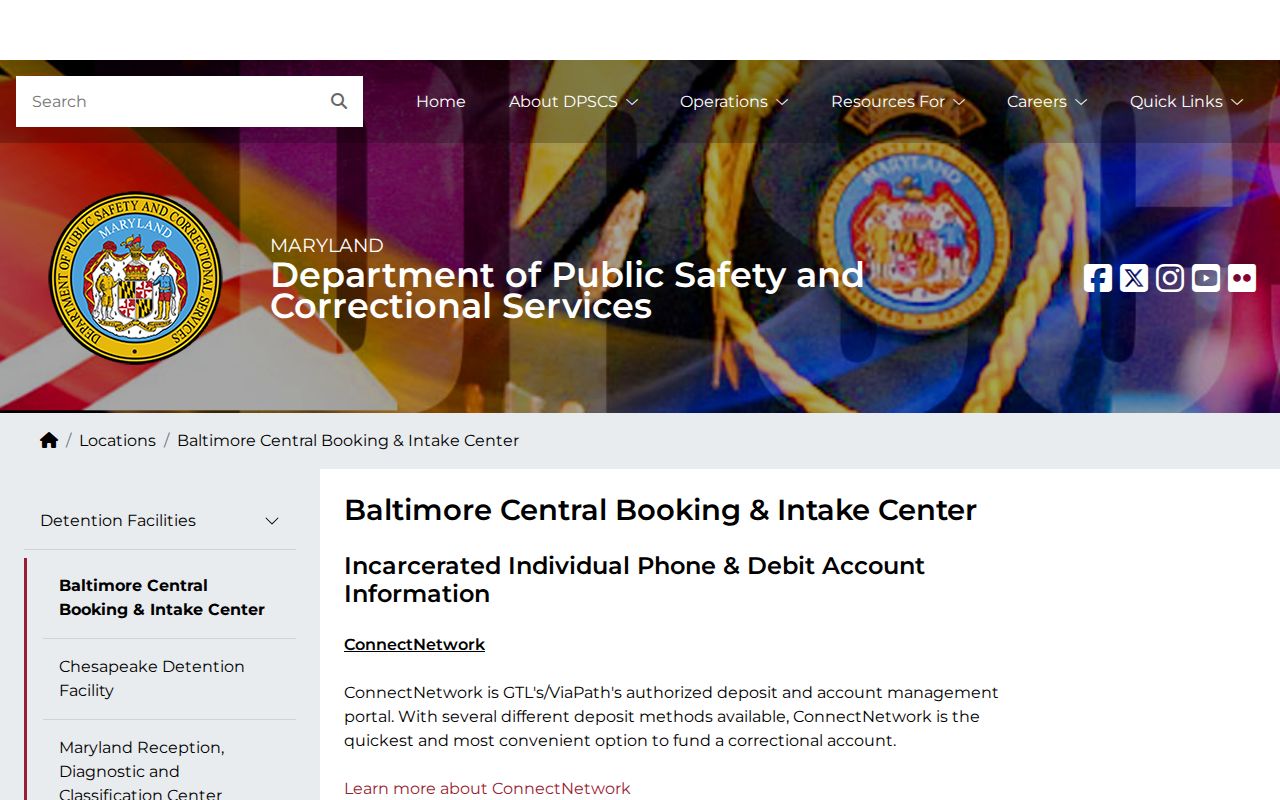
Call BCBIC at 410-545-8080 when it was the last known facility. Ask which office holds the release or transfer record, and use the case number and booking details. Staff may route the inquiry or limit disclosure by phone. That does not make the record unavailable, but it may require a formal DPSCS Public Information Act request.
A person may have moved within the complex before release. Ask for the releasing facility, recorded release type, and destination instead of assuming BCBIC completed the final action. Those fields are especially important when the three-day span crosses more than one building or custodian.
Obtain Baltimore City Release Proof
The DPSCS Public Information Act channel is the durable fallback when no online result resolves the three-day sequence. Describe an existing record, not a question. Identify the person, facility, booking or commitment, and date range. Request the recorded release or transfer date and time, type, destination, and movement history. A narrow scope reduces the chance that unrelated records obscure the custody episode.
Use the DPSCS application and submit it to dpscs.pia@maryland.gov or the Public Information Act Coordinator, Office of Constituent Services, Maryland DPSCS, 6776 Reisterstown Road, Baltimore, MD 21215-2318. DPSCS explains that the law does not require it to create a new report or recent-release list. The request should seek the record already kept in the ordinary course of agency work.
Once received, place the agency record beside the court docket and VINE event. If all three dates differ, preserve the labels rather than merging them. The order date shows legal authority, the automated alert shows a transmitted status event, and the operational record shows the custodian's action. Keep copies with the case number and source date. That three-part timeline is the soundest answer to the Baltimore City weekend-release problem.