
Baltimore City Release Meaning
A release record closes one custody episode. It does not always say that the person went home. Baltimore Central Booking and Intake Center, known as BCBIC, is a common entry point for adult bookings. Someone can leave that building after a judge orders release, after bond is posted, when a case ends, or after a short sentence. The same person can instead move within the Baltimore Pretrial Complex, enter a Maryland Division of Correction facility, or pass to another lawful custodian. The destination field matters as much as the word “release.”
Baltimore City released inmates also leave the public custody systems in different ways. Recognizance and bond address pretrial release. Time served and sentence expiration end all or part of a sentence. Probation allows a person to remain in the community under a court order, while parole follows a commission decision on a prison sentence. Mandatory or conditional release can place a state prisoner under supervision until a later maximum date. Dismissal or nolle prosequi may end a charge. A transfer, federal pickup, immigration handoff, hospitalization, or death closes one facility record without proving community return.
| Record label | What it may mean | Next confirmation |
|---|---|---|
| Recognizance or bond | Pretrial release ordered under court conditions | Court docket plus BCBIC execution record |
| Time served or expiration | A custodial term ended | Sentence and physical release record |
| Parole or conditional release | Prison custody ended while supervision may continue | MPC decision, VINE event, and DPP status |
| Transfer | The person left one building but remained in custody | Receiving facility or agency |
| Dismissal or nolle prosequi | A charge ended without a conviction on that count | Court file and release order |
Baltimore City Release Record Fields
A Baltimore City release record should be read as an agency document tied to one booking or commitment. It is not the arrest report, court docket, roster result, or parole file. A useful request names the episode and asks for existing fields. DPSCS does not have to research a broad question or create a new list. The clearest request identifies the person, the facility, the case or agency number, and an approximate date range.
| Field | What it can establish |
|---|---|
| Name and agency identifier | Which person and custody file the record concerns |
| Booking or admission date | When the documented custody episode began |
| Committing authority | The court, police agency, or other authority behind custody |
| Releasing facility | The building or division that closed its custody segment |
| Release date and time | When staff recorded the release or movement |
| Release type or reason | The basis recorded by the custodian |
| Destination or receiver | Community return, another DPSCS site, or another authority |
| Movement history | Transfers that explain why one facility stopped listing the person |
Three dates often differ. A court disposition date records a legal act. A projected date is a calculation that may change. The physical release time records when detention staff completed a release or transfer. Treating those dates as interchangeable can create a false claim about when the person left or where the person went.
Request Baltimore City Release Records
The DPSCS Maryland Public Information Act page explains how to seek an existing detention or correctional record. The request can be sent through the agency form or by email or mail. DPSCS lists its PIA Coordinator at the Office of Constituent Services, 6776 Reisterstown Road, Baltimore, MD 21215-2318, and publishes dpscs.pia@maryland.gov for requests. The time and scope of a response depend on the request, the agency’s review, and any applicable protections.
- Name the person with enough detail to avoid a mistaken identity.
- Give the Baltimore facility, booking or commitment number, court case, and a focused date range.
- Ask for the existing release or transfer record, including date, time, type, destination, and movement fields if kept.
- Request electronic delivery and ask for a cost estimate before chargeable work begins.
- If a field is withheld, ask the custodian to identify the legal basis for the denial.
DPSCS says the first two staff hours for search and preparation are free. Later work may be billed. The agency lists photocopies at 50 cents per page, with another 50 cents per page for certification plus postage, and no charge when the total is one dollar or less. A written request for a fee reduction or waiver may be granted when DPSCS finds that it serves the public interest. Protected parts may still be withheld or redacted.
The official instructions also give a separate path for a former detainee’s own base or medical file. The person or an authorized representative should contact the releasing institution or Case Management Office for Operations at 410-585-3300. That personal-file route is narrower than a general public-record request and can be more useful when the goal is to document or correct one’s own Baltimore City custody episode.
The successful capture of the DPSCS request instructions shows the agency’s records channel and former-inmate guidance.

The page confirms why a precise request for an existing release or movement record is stronger than a demand for a custom release list.
Baltimore City Former Detainee Files
A former detainee has a different route for a personal base or medical file. DPSCS directs that request to the institution that released the person or to the Case Management Office for Operations at 410-585-3300. The agency says this type of file is released only to the person or an authorized representative. That access rule separates a personal-file request from a general PIA request for a disclosable agency record.
Use this channel when a former Baltimore City detainee needs documentation from their own custody episode, wants to resolve an apparent error, or needs a retained medical or base file for a lawful personal or court-related purpose. Give the full name used in custody, the facility, the approximate dates, the booking or commitment identifier, and proof of identity or authority requested by DPSCS. Ask which institution keeps the file before sending sensitive documents.
The personal file may contain more than the narrow release event, but access does not mean every part will be supplied without review. Medical privacy, information about other people, investigatory material, and other protected content may affect the response. If the goal is only the release date, type, destination, and movement trail, a focused request for those existing fields may be faster to review than a demand for the entire file. Preserve the response with the matching court order and VINE event so each source’s role stays clear.
Baltimore City Expunged Release Records
Maryland law can limit what remains visible. An expunged case is removed from court and law-enforcement records under the governing process. Shielding is different: it can remove a qualifying matter from remote public display without erasing it in the same way. Sealed records, youth matters, and other restricted files may also be absent. The Maryland Courts adult expungement information warns people to keep their order and copies because the record may be unavailable after expungement.
This creates a Baltimore-specific problem. The court record often lasts longer than a live custody listing, but expungement may remove that durable fallback. A missing docket cannot prove that no arrest, detention, or release occurred. For help with the process, the Baltimore City District Court Help Center offers limited legal assistance on expungement. A person seeking their own detention file should preserve lawful copies before the record becomes unavailable.
Baltimore City Release Time Questions
Release logistics are state-run. The official BCBIC facility page provides location and visiting information, but it does not publish release-processing hours, a promised exit, or a family waiting point. Exact-day questions should go to BCBIC at 410-545-8080. Staff may direct a caller to the right records office without disclosing protected information by phone.
A court order and a physical departure do not share a guaranteed timestamp. Staff may need to verify the order, close property and medical steps, check warrants or detainers, and determine a receiving authority. No public Baltimore City release feed gives a dependable completion time. Family members should avoid choosing a pickup place or hour that the facility has not confirmed.
Find Baltimore City Released Inmates
Start with custody, not a broad name search. Baltimore’s state-operated structure means the last building and controlling legal authority decide which record can answer the question. A current locator result can show covered DPSCS housing. No result is only a clue. It can reflect release, escape, a name mismatch, a short-sentence omission, or custody outside the locator’s scope.
- Identify the last known custodian, facility, court case, and full legal name.
- Check the DPSCS Incarcerated Individual Locator for covered current custody.
- Read the correct Baltimore City District or Circuit Court docket for the order, sentence, warrant, and disposition.
- Search Maryland VINE for the person and any release or transfer event supplied by the agency.
- Check parole, probation, or mandatory supervision only when the sentence supports it.
- Request the exact release or transfer record from DPSCS or DPDS.
- Switch to BOP or ICE sources when federal or immigration custody may control.
A person who leaves a live roster may have been released, transferred, omitted, or moved to another system. Confirm the destination before saying the person returned to the community.
Baltimore City Custody Locator Limits
The official DPSCS Incarcerated Individual Locator asks for first and last name. It covers people committed to the Commissioner of Correction and housed in Division of Correction facilities, Patuxent Institution, and some short-sentenced people in DPDS facilities. DPSCS warns that it does not show everyone in its custody. Most important, people no longer in custody because of release or escape are not listed.
| Search item | Use | Limit |
|---|---|---|
| First name | Required name search field | Try verified legal variants |
| Last name | Required name search field | Common names need another identifier |
| Housing result | Shows covered current custody | Not a historical release record |
| No result | Signals the locator does not display the person | Does not prove release |
The official locator scope statement is visible in this captured search page.
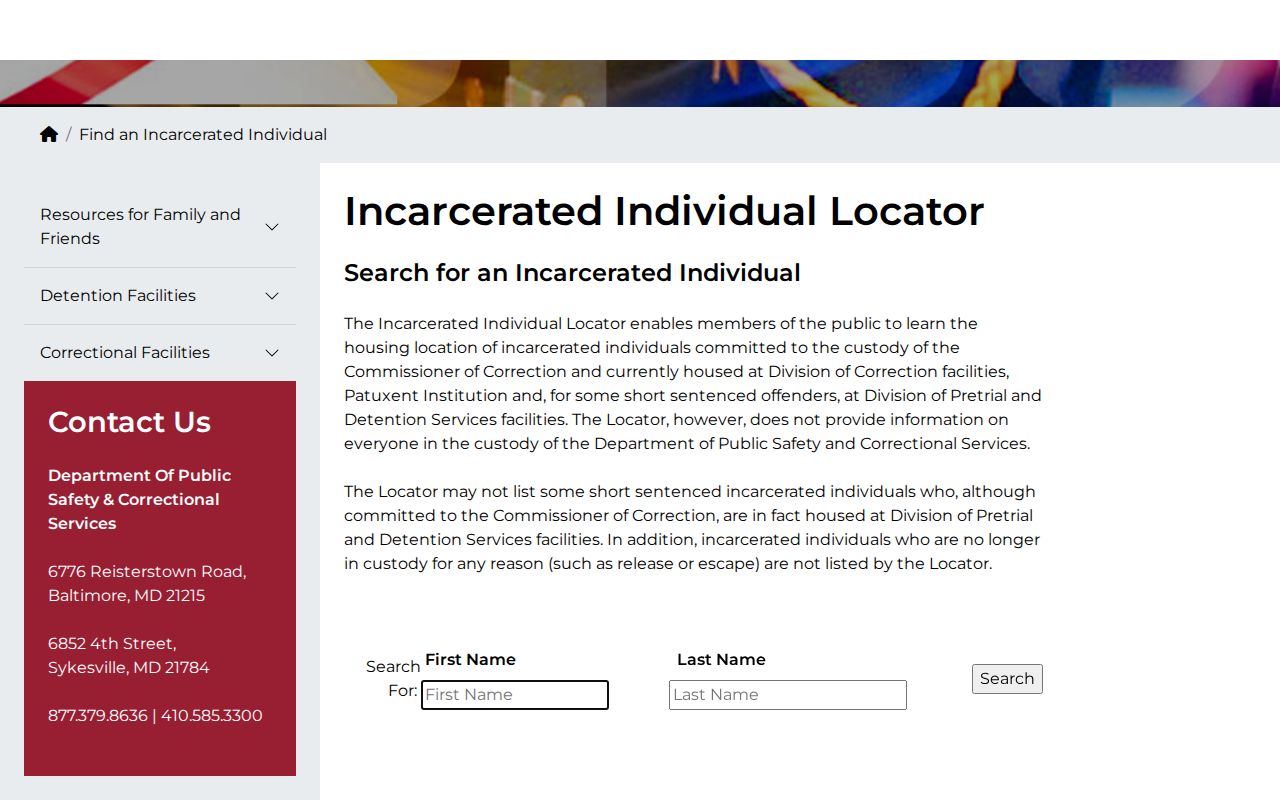
Its warning explains why a court record, VINE event, and targeted agency request must follow a failed search.
Baltimore City Release Court Search
The redesigned Maryland Judiciary Case Search and Record Portal joins the public case search and record-search functions. Baltimore City Circuit criminal data begins in 1993, while District Court criminal coverage generally reaches late 1991. Names default to exact matching. For a partial name, the system permits a starting character followed by a percent sign, but not a wildcard at the beginning or middle.
Baltimore City cases can sit at two court levels. Circuit Court general information is available at 410-333-3722. Central District Court criminal operations are now at 500 N. Calvert Street, not the closed East Fayette location, and the published number is 410-878-8900. Both list weekday clerk hours of 8:30 a.m. to 4:30 p.m., except legal holidays. A docket summary may show the order or disposition, but the clerk’s file is the route to the actual document.
The official Case Search FAQ explains those coverage and query limits.
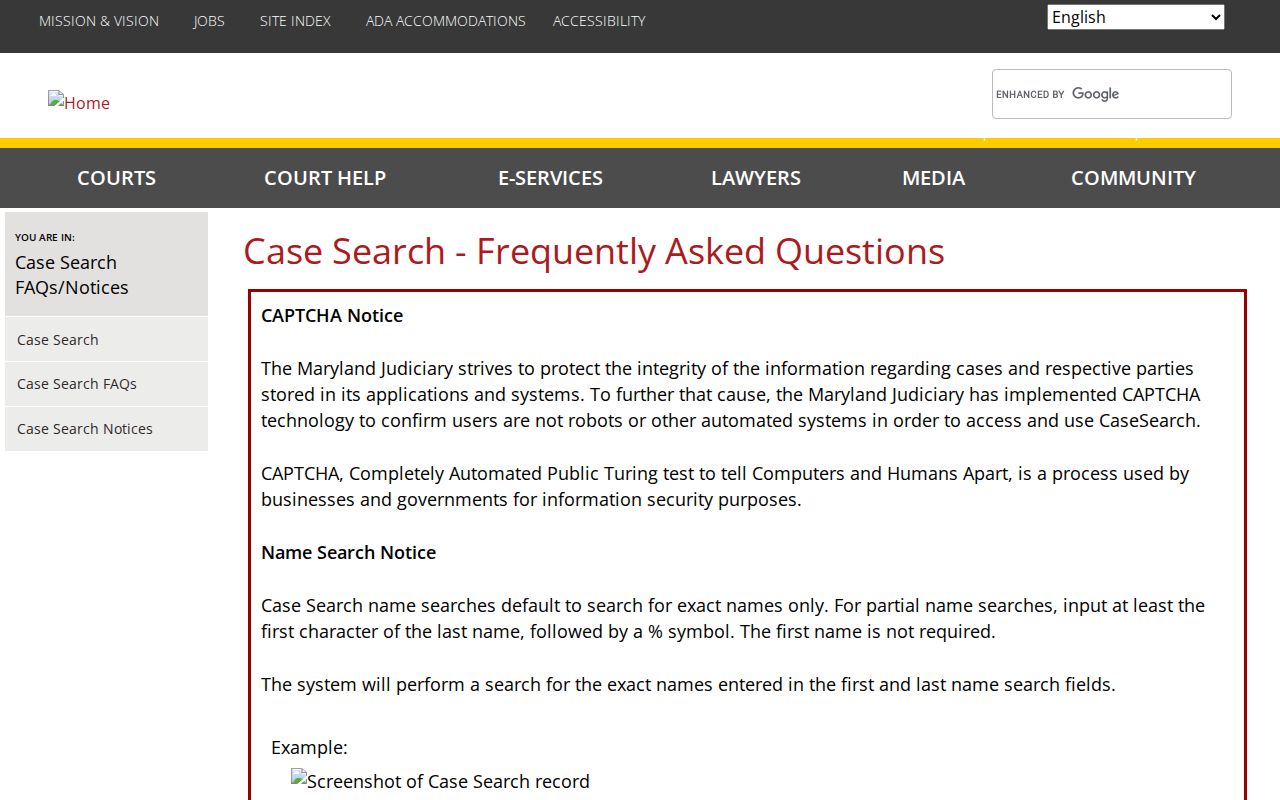
That detail is vital when a spelling variant or older case produces no remote result.
Baltimore City Release Alerts
Maryland VINE supplies automated custody, court, parole, and probation event information through VINELink, the mobile service, and 1-866-634-8463. Search the specific person, compare the reporting agency and identifying data, and register for the events offered on that record. A release alert means release from the reporting custodian. It does not rule out a transfer or another hold.
Post-release supervision requires a separate check. The Maryland Parole Commission makes parole decisions within its authority. The DPSCS Division of Parole and Probation handles field supervision for parole, probation, and mandatory release. Baltimore has several assigned field offices, not one public name-search portal. The court case, VINE event, commission record, and DPP confirmation should agree before a supervision status is stated. The Baltimore City parole and probation process explains that focused verification path.
Baltimore City Release Reentry Services
The DPSCS Reentry Services unit works across the DPDS committed population and the DOC sentenced population. Its published transition work includes a voluntary local-detention-center transfer framework for qualifying people who are within one year and at least 30 days of release. That resource can help explain the system a person moved through, but it is not proof that a named person was released.
Reentry planning and legal custody status answer different questions. A program referral may occur before the release date. Work release also remains custody until formal release. The release record, VINE event, and court or parole source remain the evidence of a custody change.
Baltimore City Federal Release Checks
Chesapeake Detention Facility has a federal pretrial role, so leaving a Maryland building can still mean federal custody. The BOP Inmate Locator searches by federal number or by name with optional identifying filters. A federal result can include a release date and location or status. “Not in BOP Custody” does not prove that no other justice-system custodian holds the person.
The ICE Online Detainee Locator System is separate. It searches by a nine-digit A-number and country of birth, or by exact name, country of birth, and optional birth date. ICE states that it includes current detainees and people released from ICE custody during the prior 60 days. A detainer can lead to a handoff after state release, so “released from DPSCS” should not become “free” unless the receiving authority is resolved.
The federal locator form shows the identifiers and release fields used for a federal search.
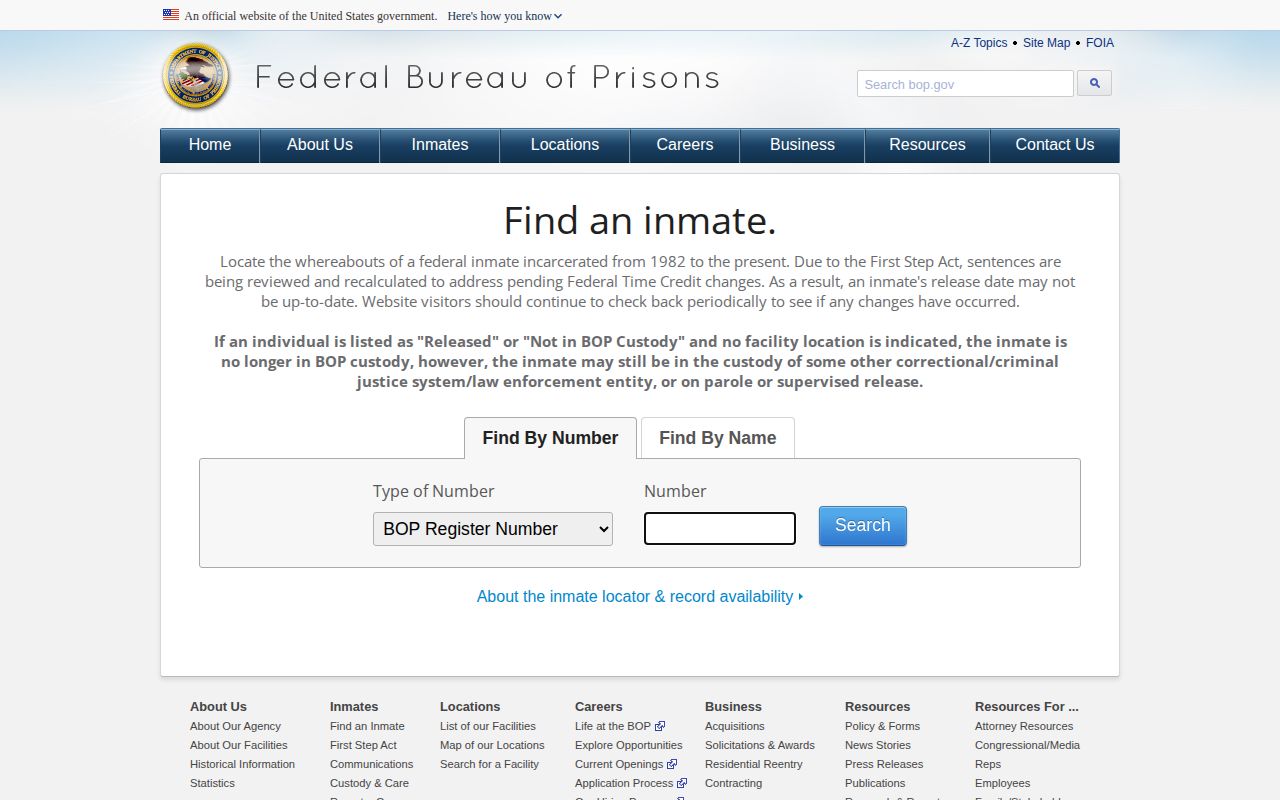
This is a federal custody source, not a substitute for Baltimore City, Maryland VINE, or ICE records.
Baltimore City Release Source Comparison
Each source answers a narrow question. Use the custodian’s own language and pair systems when the destination is uncertain.
| Source | Best use | What it cannot prove alone |
|---|---|---|
| DPSCS locator | Covered current Maryland custody | Why a person is absent or the historical release date |
| Maryland VINE | Agency-supplied custody and release events | That no receiving authority took custody |
| Judiciary portal | Order, disposition, sentence, and case history | The exact physical exit time |
| DPSCS record request | Existing release, transfer, and movement records | Information excluded or protected by law |
| BOP locator | Federal custody and released status | State or immigration status |
| ICE locator | Current or recent ICE custody within its scope | Older release history or non-ICE custody |
Baltimore City Release Facilities
Baltimore’s compact detention district contains buildings with different roles. BCBIC handles adult booking and intake. The Baltimore Pretrial Complex is a collective system, not one sheriff-run jail. Chesapeake Detention Facility can hold federal pretrial detainees. MRDCC receives and classifies state prisoners. Metropolitan Transition Center has detention, correctional, and transition functions. Youth Detention Center handles youth charged or held in the adult system, with added privacy limits. Baltimore City Correctional Center has minimum-security, pre-release, and work-release functions.
The DPSCS facility locator shows the state’s Baltimore facility list.
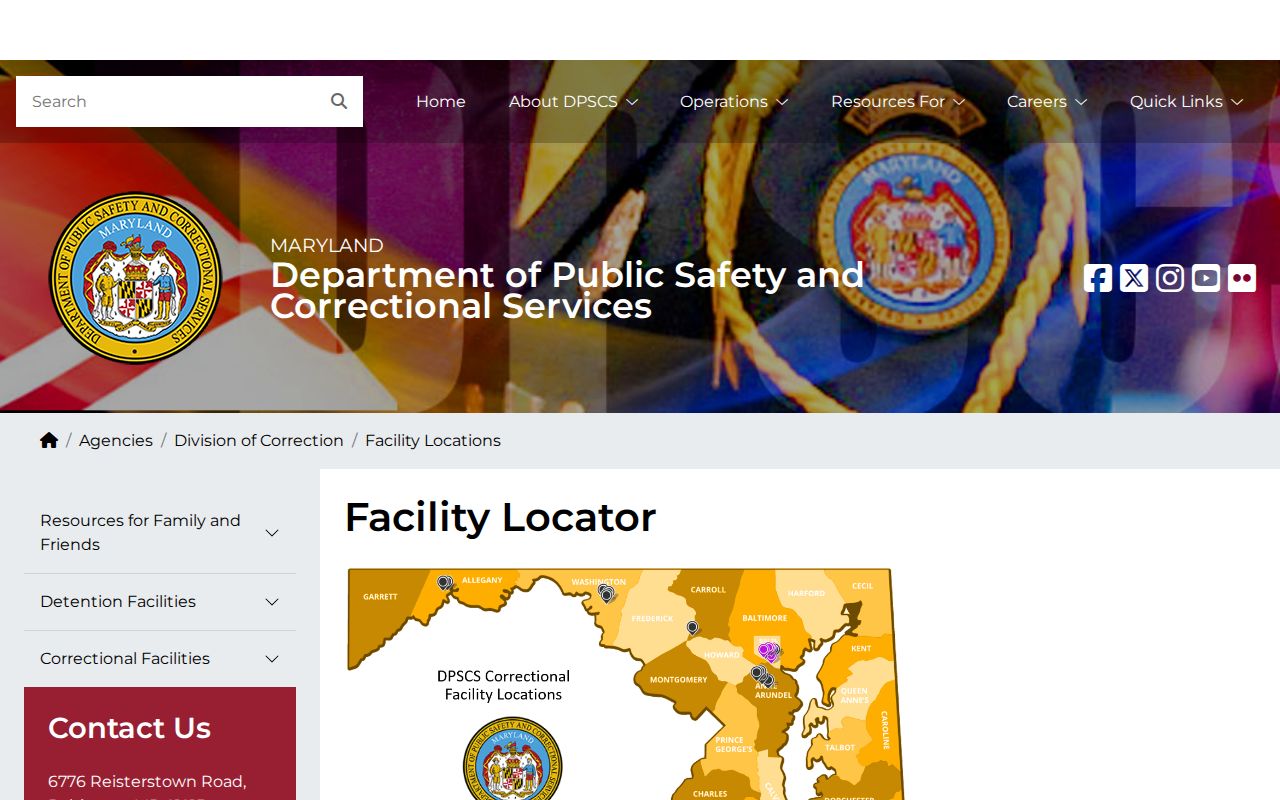
Checking only one building can make a transfer look like release, so the receiving facility must be traced.
- Baltimore Central Booking and Intake Center (BCBIC): adult booking, intake, and pretrial detention.
- Baltimore Pretrial Complex (BPC): the broader state-operated pretrial system.
- Chesapeake Detention Facility (CDF): state facility with a federal pretrial role.
- Maryland Reception, Diagnostic and Classification Center (MRDCC): state reception and classification.
- Metropolitan Transition Center (MTC): detention, correctional, and transition functions.
- Youth Detention Center (YDC): secure custody for youth in the adult system.
- Baltimore City Correctional Center (BCCC): minimum-security, pre-release, and work-release custody.