
Baltimore City 24-Hour Release Check
No official Baltimore City agency publishes a rolling list of people released during the prior day. Baltimore Central Booking and Intake Center, known as BCBIC, is operated by the Maryland Department of Public Safety and Correctional Services through its Division of Pretrial Detention and Services. It is not a sheriff-run county jail. The DPSCS Incarcerated Individual Locator shows the current location for covered people, but it has no released tab and no filter for the last day.
That gap changes the task. A public list cannot be treated as missing data waiting to load, and no complete roll call can be reconstructed from one portal. A Baltimore City same-day release check must begin with a known person and known custody episode. The key sources are the Maryland court case, a VINE event, and the BCBIC or DPDS operational record. These sources can establish the legal order, the reporting agency's event, and the action staff carried out.
Check Baltimore City Releases Today
Start with the last agency known to hold the person. A Baltimore arrest may lead through BCBIC, another building in the Baltimore Pretrial Complex, a state correctional institution, or a federal custodian. Use the case number, full legal name, booking or admission date, and agency identifier when available. Those facts prevent a common-name match from being mistaken for the right person.
- Open Maryland Judiciary Case Search. Select the correct Baltimore City case and read the newest bail, release, disposition, sentence, and warrant entries.
- Search Maryland through VINELink. Compare the reporting agency and identifying details, then read whether the event is a release, transfer, or another change.
- Check the DPSCS locator for current covered custody. A hit can show the present facility. Treat no hit only as a clue.
- Call BCBIC at 410-545-8080 when it was the last known facility. Ask which office keeps the release or transfer record for that booking.
- Request the existing DPSCS record when the exact date, time, release type, or destination matters.
The court order and the physical act are not the same event. A judge may change release conditions, dismiss a charge, or impose time served before detention staff complete identity checks, property return, and any hold review. VINE may receive its event after the agency updates its system. Reconcile the timestamps instead of choosing one as the sole answer.
For a broader named-person search across custody types, the Baltimore City released inmate search sets out the state, court, federal, and immigration paths.
Baltimore City Release Record Fields
Because there is no public same-day feed, no official Baltimore City screen supplies a fixed set of last-24-hours columns. The useful fields come from a targeted release, discharge, or transfer record. Ask for the existing record tied to one booking or commitment. Do not ask DPSCS to create a new list, since the Maryland Public Information Act does not compel the agency to build a report that does not already exist.
| Field to request | What it can establish |
|---|---|
| Full name and identifier | Connects the record to the correct person and custody episode. |
| Booking or admission date | Marks the start of the relevant facility stay. |
| Releasing facility | Names the custodian whose segment ended. |
| Release date and time | Records when staff carried out the release or transfer. |
| Release type or reason | May distinguish bond, recognizance, time served, sentence expiration, parole, or another outcome. |
| Destination or receiving authority | Shows whether the person returned to the community or moved into other custody. |
| Movement history | Helps reconcile transfers among Baltimore facilities or other agencies. |
A release type is vital. "Released from BCBIC" can mean release on bond or recognizance, but a closed facility segment may also show transfer to another DPSCS building, another jurisdiction, federal authority, or another lawful custodian. Use "returned to the community" only when the destination supports that conclusion.
Note: A docket can explain the legal basis for release, but it may not show the minute when detention staff completed processing.
When Baltimore City Releases Occur
Baltimore's release logistics are state-run. The official BCBIC page provides facility and visitation information, but it does not publish release-processing hours, a release exit, or instructions for a family waiting point. No dependable public source in the project research gives a standard time when people leave. A court order can be entered at one time, VINE can report a change later, and physical processing can finish later still.
For exact-day planning, call BCBIC directly at 410-545-8080. Ask about the specific custody episode and where an authorized inquiry should go. Staff may limit what can be disclosed by phone, so a call is often a routing step rather than a durable release record. Do not infer an exit location from a street address or assume that every person booked there leaves through the same door.
The same caution applies to property return. Research does not establish a universal pickup procedure for Baltimore City releases. The facility holding the person should confirm its process. That keeps practical plans tied to the actual building and avoids sending someone to the wrong part of the multi-facility complex.
Baltimore City Locator Release Gaps
The Maryland locator creates a distinctive same-day problem. DPSCS expressly says that people no longer in custody for any reason, including release or escape, are not listed. It also warns that it may omit some people serving short sentences in DPDS facilities. A failed Baltimore City search therefore cannot distinguish several very different events.
- Release
- The named custodian ended the custody episode, with the destination still needing confirmation.
- Transfer
- The person moved to another facility or authority and remained in custody.
- Locator omission
- The person may be in a DPSCS category that the public locator does not display.
- Name mismatch
- The record may use a verified legal-name variant or another spelling.
This ambiguity is why a court, VINE, and records chain is stronger than a screen capture of an empty result. A court order can show what should happen. VINE can report what a participating agency transmitted. The release or movement record can show what the holding agency recorded. Together they resolve far more than the locator alone.
Note: A transfer alert closes one custody segment but does not show that the person is free of every other lawful hold.
Request Baltimore City Release Records
When exact proof is needed, ask DPSCS for an existing release or transfer record rather than for a custom list of everyone released today. A narrow request should identify the person, facility, booking or commitment, and date range. It should name the desired fields, such as the recorded release time, type, destination, and movement history. The agency can then search for a defined record instead of being asked to answer an open-ended question.
The DPSCS Public Information Act page explains this official route and the special instructions for former detainee files.
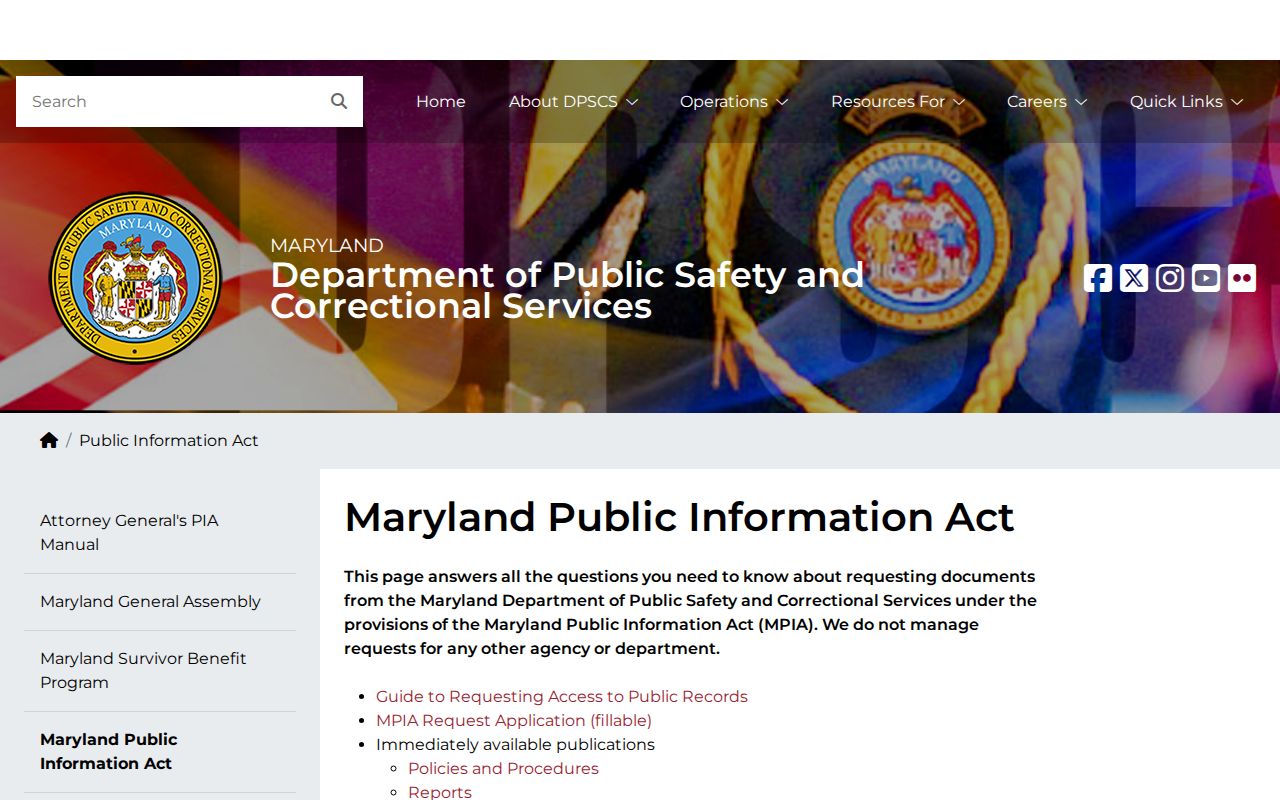
Submit the DPSCS PIA application by email to dpscs.pia@maryland.gov or by mail to the Public Information Act Coordinator, Office of Constituent Services, Maryland DPSCS, 6776 Reisterstown Road, Baltimore, MD 21215-2318. Preserve the response and any cited exemption. Then compare the record with the court order and VINE event if the physical release time is important.
Baltimore City Release or Transfer
A person still shown at a covered DPSCS location is in current custody according to that feed. A person absent from the locator has an unresolved status until another source explains the absence. The distinction is especially important in Baltimore, where several state-run facilities serve different booking, pretrial, classification, correctional, youth, and federal-contract functions within a small area.
| Situation | Best next source | Safe conclusion |
|---|---|---|
| Current DPSCS location appears | DPSCS locator and facility | The person is shown in covered DPSCS custody. |
| Release event appears in VINE | Reporting agency and court | The reporting custody changed; destination must be checked. |
| Baltimore court orders release | BCBIC or DPDS record | Legal authority exists; physical processing may follow. |
| Federal case controls | BOP locator and federal docket | A Maryland result does not resolve federal custody. |
| ICE may receive custody | ICE locator and case channel | Release from DPSCS may be an immigration transfer. |
For a same-day check, attach the custodian to every claim. "Released from BCBIC" is precise. "Released from custody" is broader and may be wrong when another agency received the person.
Extend Baltimore City Release Checks
A same-day search can miss an event that was authorized before midnight but processed or transmitted afterward. It can also miss a person whose name or case details were entered differently. When the known time is uncertain, expand the date range and compare each source's timestamp. The Baltimore City released last 72 hours workflow is built for that wider, multi-day review.
The broader window still does not create an official roster. It gives more room to reconcile a court event, VINE alert, facility action, and receiving authority. Keep the person and custody episode fixed while widening the dates. That approach finds a late-posted event without mixing unrelated people into an invented recent-release list.