
Baltimore Parole and Probation
Maryland divides the work among separate bodies. The Maryland Parole Commission decides parole matters within its authority. The Maryland Department of Public Safety and Correctional Services Division of Parole and Probation, often called DPP, handles field supervision for parole, probation, and mandatory-release cases. A Baltimore City court imposes probation. Release on bond before trial is neither parole nor probation unless a separate case already created that status.
The distinction affects which record proves the status. A court judgment can show that probation was ordered. A written Commission order can show a parole decision. DPP can identify the assigned office and say what current information may be released. None of those records alone proves the exact time someone physically left a Baltimore detention facility.
| Point | Parole | Probation |
|---|---|---|
| How it begins | A Commission decision permits release from a sentence under conditions | A court orders community supervision as part of a judgment |
| Main decision record | Maryland Parole Commission order | Baltimore City court judgment and docket |
| Field supervision | DPP | DPP |
| Custody meaning | The person may be out of prison but still serving a supervised term | The person may never have served a prison term, or probation may follow confinement |
| How it ends | Discharge, expiration, or another lawful Commission action | Expiration, discharge, or a later court action |
Conditional or mandatory release is another distinct path. It can place a person under DPP supervision through the sentence’s maximum expiration date. Unconditional discharge means the custodial sentence and any linked release supervision have ended. The exact label matters.
Verify Baltimore City Post-Release Supervision
No public DPP portal allows a general name search for active Baltimore City supervision. Verification therefore requires a record chain. Start with the case, not a rumor or an old custody page. Maryland Judiciary Case Search may show the sentence and whether probation was imposed, but it cannot prove that supervision remains active today.
- Find the correct Baltimore City District or Circuit Court case and record its case number, sentence, and disposition.
- Identify the status stated in the record: parole, probation, mandatory or conditional release, sentence expiration, or another outcome.
- Check Maryland VINE when the person and event are available. The state materials include parole and probation status events.
- Contact DPP with the full name, court case number, and state identifier, if known. Ask which office has the assignment and what may be confirmed.
- For parole, obtain the written Commission result. Do not treat a hearing date as a grant.
- Pair the supervision result with a custody event or release record if physical release also needs confirmation.
A released Baltimore City person may be under supervision even after disappearing from the locator. The reverse is also possible: a person can complete a sentence without parole or probation. The broader Baltimore City released-inmate search path explains how court, VINE, and release records fit together.
Baltimore Parole Hearing Records
The Commission’s hearing material must be read with care. Its open-hearing master list may show a hearing date, time, institution, a person’s name, and DOC number. Baltimore City Correctional Center matters can appear there. A listing shows that a hearing was scheduled or placed on the public list. It does not show that parole was granted or that release occurred.
The Maryland Parole Commission hearing FAQ explains three main result terms. “Refuse” means no further parole hearings. “Rehear” sets another review at a later point. “Approve” means release may follow after required pre-release conditions are met. Approval is not the same as a completed release. Processing, conditions, or another hold can still prevent immediate departure.
Eligibility must also be kept apart from the hearing result. Correctional Services § 7-301 sets the general parole framework and special rules for covered violent crimes, life terms, and other categories. A date on which the Commission may consider a person is not an expected release date. The Commission still makes a case-specific decision. For some defined offenses, § 7-301.1 provides a separate administrative-release process and a tentative eligibility date, but that date is not shown in the public DPSCS custody locator.
The official hearing-process page is shown below. Its labels help distinguish a decision from the later release event.
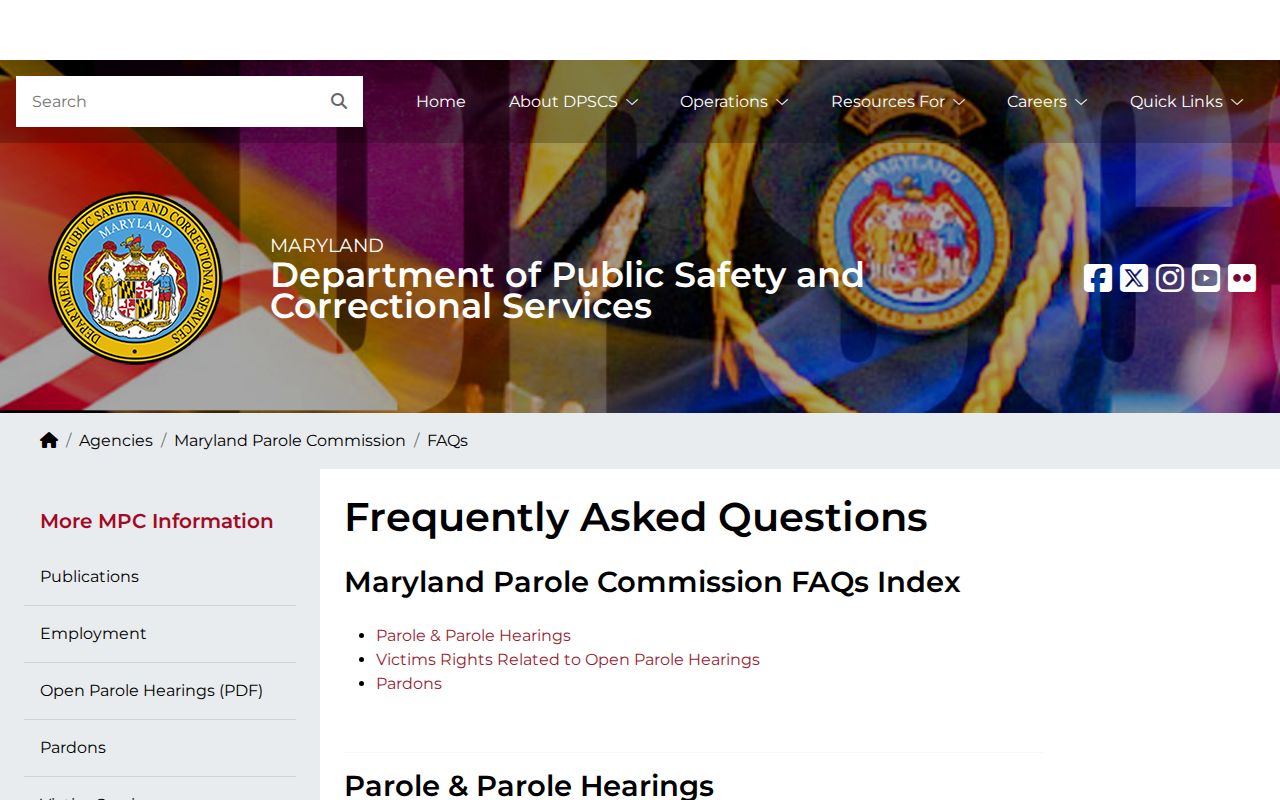
For a defensible check, pair the decision with a DPSCS or VINE custody event and DPP confirmation. No public searchable database of all individual Commission results was located.
Note: A public-business meeting and an individual parole hearing are different events, and neither one alone proves physical release.
Baltimore City Supervision Offices
Baltimore City has five listed field-office routes. Assignment controls where a person reports. Proximity to a home address does not. The DPP office locator is the source for the current office table and should be checked before visiting or mailing anything.
DPP central line
410-585-3500
Baltimore field offices
Northeast: 428 E. Preston Street, 410-962-6300
Northwest/DDMP: 4750 Mount Hope Drive, 410-764-5800
Southern: 700 E. Patapsco Avenue, 410-878-8250
Southeast: 3027 E. Madison Street, 410-537-7300
Southwest: 1401 Severn Street, Suite A103, 410-637-4200
The official Baltimore field-office table provides the same route in a page view.
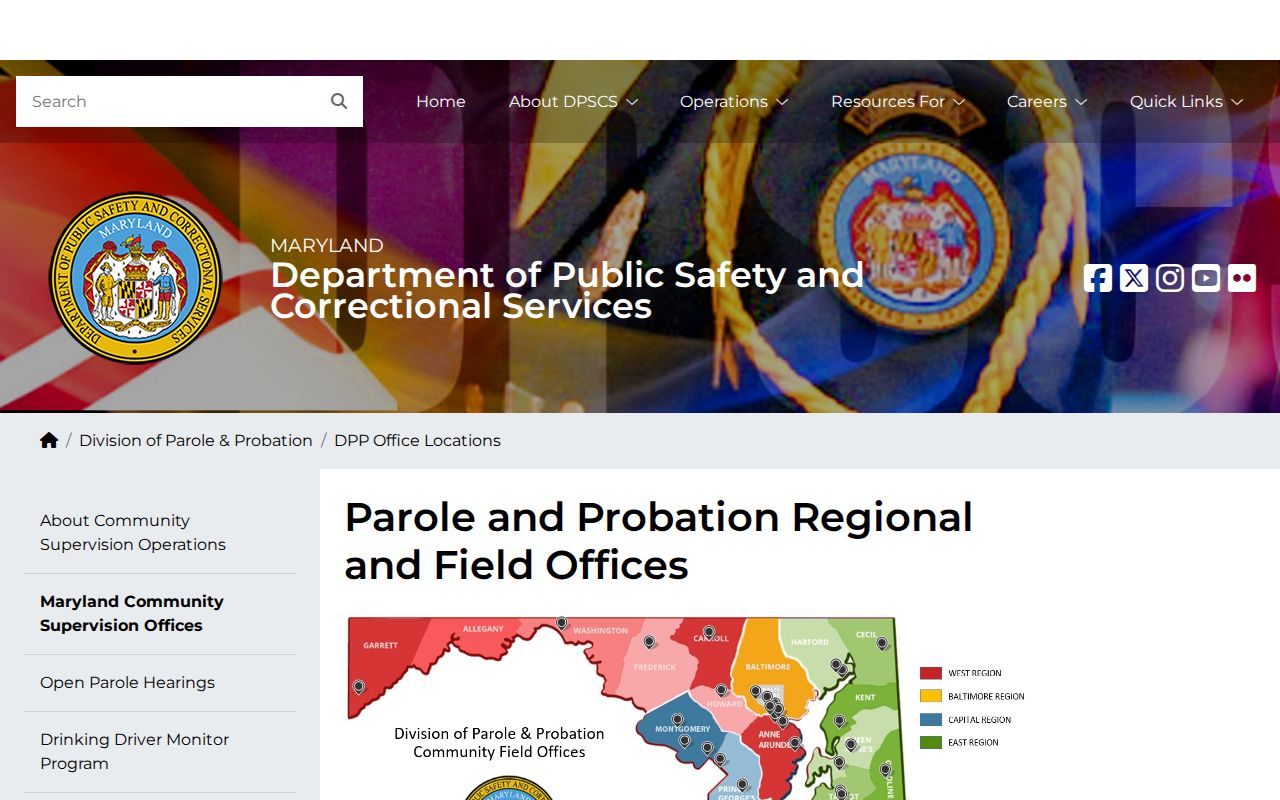
The image confirms that Baltimore supervision is routed through several state offices rather than one city probation counter. Call the central line when the assigned office is not known.
DPP Victim Services has a separate case-focused route at 6776 Reisterstown Road, Suite 310-38, Baltimore, MD 21215. Maryland VINE is also available by phone at 1-866-634-8463. Those channels support lawful notification and specific supervision questions. They do not replace the assigned field office, and they are not a public directory of every person under supervision. Give the case number and known state identifier so staff can route the request without relying on a common name.
Baltimore Supervision Status Terms
Conditions can include reporting, approved residence, treatment, travel limits, payment duties set by law or court order, and compliance with other case-specific rules. The public record may not state every term. A violation allegation starts a process; it is not a final finding by itself. A warrant may authorize arrest, yet it does not prove where the person is now.
- Parole
- Conditional release from a sentence after a Commission decision, with supervision for the set term.
- Probation
- Court-ordered supervision in the community, either instead of or after confinement.
- Mandatory release
- Release based on sentence calculation and credits, often followed by supervision until maximum expiration.
- Absconder
- A supervision label alleging that a person stopped reporting or cannot be located as required.
- Retake warrant
- Official authority to take a supervised person into custody for the violation process.
- Discharge
- The formal end of the relevant sentence or supervision obligation.
Maryland Correctional Services § 6-117 adds an important nuance. It defines “abatement” as ending active supervision or home detention without changing some continuing legal duties. Thus, “not actively reporting” and “fully discharged” are not safe substitutes for one another.
No Baltimore City-specific public absconder list was found in the official-source review. If a warrant or violation status matters, rely on the court, Commission, or DPP record that created it. A stale online reference may outlive a recall, resolution, or later hearing. Even a current warrant shows legal authority for custody; it does not identify the person’s present location.
Baltimore Release Reentry Services
DPSCS operates a reentry unit across Baltimore’s state-run detention setting and the Division of Correction population. Its Reentry Services program describes transition work for both DPDS committed individuals and DOC-sentenced individuals. It also describes a voluntary local-detention-center transfer framework for qualifying people who are within one year, but at least 30 days, of release.
This resource can help explain which state unit supports release planning. It does not confirm that a named person was approved, transferred, or released. Those facts still require the person’s case and agency records. Baltimore City’s state-operated structure makes that distinction especially important because pretrial, sentenced, and transition populations can move through nearby facilities under different legal authority.
Note: Reentry program eligibility is a service question, not a public supervision-status result or a release record.
Baltimore Former-Detainee File Access
A former detainee seeking a personal base or medical file has a route apart from a broad public-record request. The DPSCS Public Information Act guide directs that person to the releasing institution or the Case Management Office for Operations at 410-585-3300. DPSCS says this material is releasable only to the former detainee or an authorized representative.
That channel is useful when the person needs to document a custody episode, inspect retained case information, or address an error in a personal file. It is not an open lookup for another person’s record. Include the full legal name, identifier, releasing institution, and approximate dates so staff can locate the right file. For a supervision question, contact DPP instead. For a parole decision, use the Commission’s written order.